How Dubai Built an Economy Without Oil
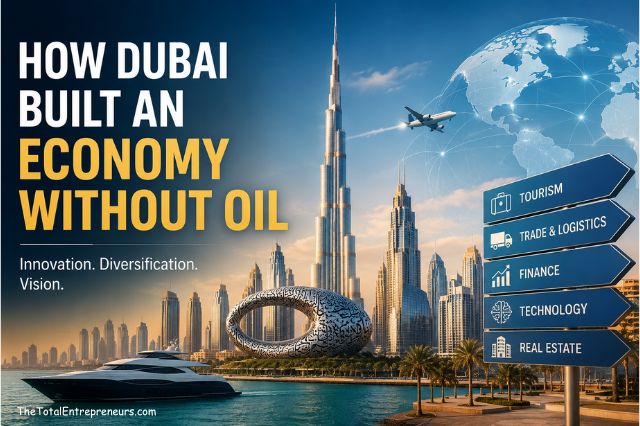
Dubai’s diversification is most often told as a story about running out of oil early and having no other choice. The timeline doesn’t support that framing. The emirate’s most consequential economic decisions, the ones that actually built the non-oil economy, were legal and regulatory choices made years apart, each one removing a specific barrier that had kept foreign capital and foreign ownership at arm’s length. None of them required oil to run out first.
1985: A Free Zone With No Local Partner Required
Jebel Ali Port opened in 1979. Six years later, Dubai’s ruler established the Jebel Ali Free Zone by decree, and the change it introduced was narrow but structural: everywhere else in the UAE at the time, a foreign company setting up business needed a local partner or sponsor holding at least 51% of the enterprise. Inside the free zone’s boundary, that requirement didn’t apply. A foreign company could own 100% of its operation, repatriate its profits without restriction, and pay no corporate tax for an initial period that stretched to 50 years.
19 companies registered in the free zone’s first year. By the time Dubai’s government last published the figures, the zone accounted for 21% of Dubai’s GDP annually, drew 32% of total UAE foreign direct investment, and supported more than 144,000 jobs. Every free zone Dubai built afterward, and the emirate now operates dozens of them, used the same basic template: full foreign ownership inside a defined legal perimeter, in exchange for capital and jobs that would otherwise have gone to a jurisdiction that didn’t require a local partner at all.
2002: Foreigners Could Finally Own the Building
For the first two decades of the free zone model, foreign investors could own a business in Dubai but not the real estate under it. That changed in May 2002, when Dubai’s then-Crown Prince issued a decree permitting non-GCC foreigners to hold freehold title to property for the first time, in a set of designated areas that would go on to include Dubai Marina, Palm Jumeirah, and Downtown Dubai. Before the decree, land ownership in Dubai was restricted to UAE and GCC nationals. After it was issued, a foreign buyer could hold outright, sellable, inheritable title to an apartment or villa in the same way a citizen could.
That single change reoriented what Dubai’s real estate sector was building for. Property development stopped being a domestic construction business serving local demand and became an export product sold directly to a global buyer, which is the difference between the emirate’s skyline before 2002 and the one that exists today.
2004: A Financial Center With Its Own Court System
The most structurally unusual of the three decisions came in 2004, when Dubai established the Dubai International Financial Centre as a financial free zone with its own independent civil and commercial legal framework, separate from UAE federal law. The centre runs on an English-language common law system with its own courts, rather than the civil law framework used elsewhere in the country, specifically so that international banks, asset managers, and insurers could operate under legal rules their compliance departments already understood.
That was, in effect, the strategy Dubai had been running since 1985: build a legal channel that attracts international investors, attracts people from everywhere to live in Dubai and to spend money in Dubai, rather than compete on the price of the commodity underneath it. By the most recent count, the centre had grown to 8,844 active registered companies, with the wealth and asset management cluster alone managing $176 billion in assets, up 4% in a single year. Dubai’s overall standing on the Global Financial Centres Index reached seventh place globally in early 2026, its highest ranking on record.
Three Decisions, One Pattern
None of these three moves, the free zone in 1985, the property law in 2002, the financial centre in 2004, addressed oil directly. Each one identified a specific legal restriction that was keeping a category of foreign capital out of Dubai, and removed exactly that restriction inside a bounded jurisdiction, without rewriting the rules everywhere else in the emirate at once. That’s a narrower and more replicable pattern than “diversify the economy” as a policy goal, and it’s the pattern the data traces back to at every stage of Dubai’s transformation.