Interview with Adnan Ghaffar: The Entrepreneur Behind CodeAutomation
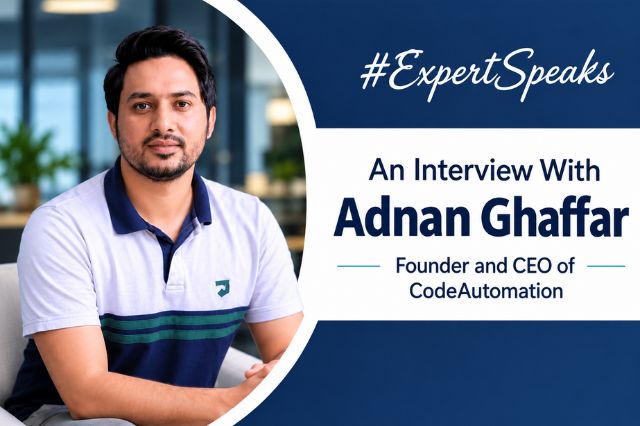
In this Interview, Developer Adnan Ghaffar told The Total Entrepreneurs how his passion for technology drove him to create a successful software development company. Adnan Ghaffar is the Founder and CEO of CodeAutomation. I encourage you to read this inspiring interview as he shares how he discovered entrepreneurship, the challenges he faced, what makes his company unique, the future of AI and automation, and advice to prospective and young developers.
Let’s get to it…
Getting to Know Adnan Ghaffar
For people meeting you for the first time, who is Adnan Ghaffar beyond the title of Founder and CEO of CodeAutomation?
Beyond the title, I’m someone who has always been fascinated by how technology can solve real problems. At my core, I’m an engineer and a builder. My curiosity has always pulled me toward the intersection of artificial intelligence, machine learning, and geospatial technology. A big part of my work centers on GeoAI and AI-powered geospatial solutions, where I get to combine GIS with modern AI to help organizations make sense of complex, location-driven data. So while the title says “Founder and CEO,” what really defines me is a genuine passion for understanding emerging technology and putting it to practical use in ways that create lasting value.
Hmm.. That’s great. So, what was your childhood like, and where did you grow up? What are some of the values your upbringing gave you that still influence the way you live and work today?
I grew up in a small town, and looking back, that environment shaped me in ways I deeply appreciate today. Being a naturally curious child, I wanted to understand how things worked, always asking questions. I spent a lot of time watching animated movies, and I think that early sense of wonder and imagination stayed with me as I grew older and channeled it into technology.
The values my upbringing gave me are ones I still carry into my work every day. Honesty was instilled in me early on, and it has become the foundation of how I operate. As a consultant, I’ve always believed in giving clients honest, straightforward feedback even when it isn’t what they expect to hear, because that’s what earns real trust. Alongside honesty, I learned the importance of leadership: taking responsibility, standing by your decisions, and guiding others with integrity. Those simple values from a small-town upbringing continue to influence how I lead my company and treat the people around me.
Education and the Journey into Technology
Tell us about your educational journey. What did you study, and why did you choose that field?
My educational journey has been anything but linear, and I think that’s actually been one of my greatest strengths. My path took me through several fields. I explored medical studies early on, spent significant time in information technology, and developed a deep focus on GIS and GeoAI. Along the way, I also invested in learning project management, which gave me the ability to lead teams and deliver complex work at scale.
What drew me to technology, ultimately, was that same curiosity I’ve carried since childhood. I wanted to understand how systems worked and how they could be improved. Each field I studied added a different layer to how I think: the analytical discipline, the technical depth, and the ability to bridge specialized knowledge with practical execution. That combination is what eventually led me toward software development, AI, and automation.
How did your education prepare you for the career you eventually built in software development, AI, and automation?
My education gave me something more valuable than any single technical skill. It gave me the ability to learn, adapt, and connect ideas across disciplines. Moving through medical studies, IT, GIS, and project management taught me how to approach problems from multiple angles, and that has been essential in a career built on solving complex challenges.
The technical grounding prepared me to understand software and systems deeply, while the project management side taught me how to translate that knowledge into real deliverables for clients. But perhaps the most important thing my education instilled was a mindset of continuous learning. In a field like AI and automation, the tools and techniques change constantly. What prepared me most wasn’t memorizing any particular technology; it was learning how to keep learning, which is exactly what this industry demands.
How important do you think formal education is for someone who wants to become a successful software developer today, especially when so much knowledge is available online?
I believe formal education still holds real value, but I don’t think it’s the only path anymore. And I say that as someone whose own journey was shaped by both structured study and self-driven learning. Formal education gives you discipline, a strong theoretical foundation, and a way of thinking through problems methodically. Those things matter, and they can accelerate your growth significantly.
That said, we’re living in an era where an incredible amount of knowledge is freely available online. A motivated person today can genuinely build a career through self-learning, hands-on projects, and the resources at their fingertips. So my honest view is this: formal education is a strong advantage, but it isn’t a strict requirement. What matters most is a genuine willingness to learn, the discipline to keep practicing, and the drive to build real things. Whether that comes from a classroom or from your own initiative, the outcome is what counts.
Discovering Entrepreneurship
Was CodeAutomation born from a specific problem you wanted to solve, an opportunity you identified, or simply a desire to build something of your own?
CodeAutomation was truly born out of a problem I wanted to solve. Through my early work, I kept noticing the same recurring challenge: businesses were dealing with repetitive, manual processes and a real lack of stability in how their operations ran.
I saw a clear opportunity to change that by using automation, and later, AI applications, to help clients work smarter and more efficiently.
That’s really what set everything in motion. I wanted to build solutions that could take these automated problems off businesses’ plates and give them reliable, scalable systems. It started with identifying a genuine gap in the market, but it grew into something more: a desire to build a company that could deliver that value at scale and help organizations transform the way they operate.
What was the hardest part of starting CodeAutomation from scratch?
The hardest part was executing on the vision at a time when the technology itself was still maturing. When I started, AI wasn’t in the boom as we see today, so bringing AI-driven ideas to life was genuinely difficult. The tools weren’t as advanced, the market wasn’t as ready, and convincing people of what was possible took real effort.
On top of that, building the team was a major challenge. Hiring the right talent, earning their trust, and getting them to believe in the vision all took time. In the early days, we didn’t have an established portfolio to point to, so a lot of it came down to demonstrating credibility through the quality of our work and our commitment. Overcoming those early hurdles, the technology, the hiring, and building trust from nothing, was easily the toughest part of the journey, but it also laid the foundation for everything we’ve built since.
Also read: How to Find and Retain Top Talents in Your Organisation
How did you get your first clients, and what did those early customers teach you about running a technology business?
Our very first clients came through references, people who trusted us based on the relationships and reputation we had begun to build. That first client, earned through a personal reference, was pivotal. It gave us the opportunity to prove ourselves, and from there, word began to spread.
What those early customers taught me was invaluable. I learned that in a technology business, trust is everything. Clients aren’t just buying code; they’re placing confidence in you to solve their problems and stand behind your work. I learned to listen carefully, deliver on my promises, and treat every project as a chance to build a lasting relationship rather than a one-time transaction. Those early lessons about trust, reliability, and client relationships still guide how we run the company today.
Did you ever experience a period when CodeAutomation was struggling and you seriously questioned whether the business would survive? What happened?
Yes, I’ve faced those difficult moments more than once. Like many founders, there were periods when we ran into serious budget constraints and had to make tough calls about how to keep things moving forward. Those were the times that truly tested my resilience.
One of the ways I navigated this was by starting a subsidiary company that could help fund and sustain CodeAutomation through the harder stretches. It was a strategic decision born out of necessity. I needed to find a way to keep the vision alive while we weathered the financial pressure. Those experiences were incredibly challenging, but they taught me resilience and resourcefulness. They forced me to think creatively about sustainability, and ultimately, coming through them made both me and the company far stronger.
Building CodeAutomation
For someone hearing about CodeAutomation for the first time, what exactly does the company do?
At its core, CodeAutomation is a US-based AI software development and business automation company. We help organizations design and implement technology that delivers real, long-term value. In practical terms, that means we build production-ready AI systems, develop custom software, create intelligent automation workflows, and guide businesses through meaningful digital transformation.
What sets our work apart is the focus on practical outcomes. We’re not building technology for its own sake, we’re solving genuine operational problems. Whether it’s deploying AI agents to automate customer support and internal operations, streamlining repetitive business processes, or building scalable software platforms, our goal is always to make our clients’ operations faster, smarter, and more reliable. We partner with startups and enterprises across the United States and around the world to make that happen.
CodeAutomation is a US-based AI software development and business automation company.
CodeAutomation has evolved toward AI-driven automation, custom software, intelligent workflows, and business transformation. Why did you believe automation would become such an important part of the future?
I believed in automation early because I could see a fundamental truth: businesses everywhere were spending enormous amounts of time and resources on repetitive, manual work that technology could handle far more efficiently. That inefficiency was universal. It cut across every industry, and I knew that whoever could solve it would be addressing a genuine, lasting need.
Automation wasn’t a passing trend to me; it was the logical direction the entire industry was heading. As technology matured and AI entered the picture, that conviction only grew stronger. I could see that intelligent automation would fundamentally reshape how organizations operate, freeing people from routine tasks and allowing them to focus on higher-value, strategic work. Betting on automation was really a bet on the future of how businesses would need to run, and that belief has proven true time and again.
What makes CodeAutomation different from the thousands of software development and AI companies competing in the market today?
What truly sets us apart is our commitment to practical, production-ready solutions rather than experimental proofs of concept. A lot of companies can build something that looks impressive in a demo but struggles to hold up in the real world. Our focus has always been on delivering systems that actually work at scale, reliable, secure, and built to last.
We evaluate every system we build against four core pillars: usability, performance, security, and long-term maintainability. That discipline ensures we’re not just solving today’s problem, but building something that continues to serve our clients well into the future. Beyond that, our difference comes down to how we work with clients. We bring honest, consultative guidance rather than just taking orders. We help businesses adopt AI and automation responsibly, without overengineering or unnecessary cost. That combination of technical excellence, practical focus, and genuine partnership is what makes us stand out.
What has been your biggest achievement since founding CodeAutomation?
My biggest achievement has been successfully automating our clients’ operations through AI in ways that delivered measurable, transformative results. We’ve helped organizations dramatically shorten the time it takes to complete critical work, turning processes that once took days into ones that take hours. Seeing that kind of tangible impact on our clients’ businesses is deeply rewarding.
Equally significant to me is what we’ve built internally. I take real pride in having trained and developed an engineering team capable of moving quickly, taking products from concept to production in remarkably short timeframes. Building that kind of high-performing team, one that can consistently deliver at speed without sacrificing quality, is an achievement I value just as much as any individual project. Ultimately, it’s the combination of client impact and team capability that I’m most proud of.
What has been your biggest mistake as a developer, and what did it teach you?
One of the biggest lessons I learned early on was the importance of having a proper development system in place, particularly a robust process for evaluation before taking anything to production. In the earlier stages, we didn’t always have the rigorous systems we needed to properly test and validate our work, and that taught me a valuable lesson.
The experience pushed me to build a much more disciplined approach: establishing proper evaluation frameworks and quality checks that ensure everything is thoroughly vetted before it reaches production level. It taught me that speed means very little without reliability and that investing in solid processes upfront saves you from far greater problems down the line. That lesson fundamentally shaped how we build and deliver software today.
Leadership and Building a Team
What qualities do you look for when hiring developers and other technology professionals?
When I’m hiring, technical skill is important, but it’s rarely the only thing I’m looking for. I want genuinely curious people, individuals who have a real passion for learning and staying ahead of a fast-moving industry. Technology changes constantly, and the people who thrive are the ones who never stop growing.
Beyond that, I look for honesty and integrity, because those values are at the heart of how we operate. I want team members who take ownership of their work, who communicate openly, and who can be trusted to deliver on their commitments. Problem-solving ability matters enormously too. I value people who can think critically and find practical solutions rather than just following instructions. Ultimately, I’m looking for a combination of technical capability, character, and the drive to keep improving. When you bring those qualities together, you build a team that can accomplish remarkable things.
How do you deal with failure, disagreements, or difficult decisions as a leader?
I’ve come to see failure as a natural and even necessary part of building something meaningful. When things go wrong, I try not to dwell on blame; instead, I focus on understanding what happened, learning from it, and making sure we come out stronger. Some of my most valuable lessons have come directly from setbacks.
When it comes to disagreements, I believe in open, honest dialogue. I encourage my team to speak their minds, because the best decisions come from hearing different perspectives and challenging assumptions. As for difficult decisions, I try to approach them with clarity and a long-term view, weighing the facts carefully, considering the impact on both our clients and our people, and then committing fully once a decision is made. Leadership isn’t about avoiding hard moments; it’s about facing them with honesty, composure, and a genuine commitment to doing what’s right.
AI, Automation and the Future of Technology
AI is transforming the software industry at an incredible speed. How do you think the role of software developers will change over the next five to ten years?
I believe the role of software developers is going to evolve significantly, but not in the way some people fear. Rather than being replaced, developers will shift toward higher-value work. The repetitive, time-consuming aspects of coding will increasingly be handled by AI, which frees developers to focus on architecture, problem-solving, creativity, and strategic thinking.
To put the change in perspective, work that once required a team of resources over several days can now be accomplished in a matter of hours. That shift means developers will spend far less time on routine implementation and much more time guiding the technology, ensuring quality, and applying the human judgment that AI simply cannot replicate. In the next five to ten years, I see developers becoming orchestrators of intelligent systems, people who direct and refine AI rather than just writing every line of code by hand. The most successful ones will be those who learn to collaborate with AI most effectively.
Do you believe AI will replace software developers, or will it make developers significantly more productive?
I firmly believe AI will make developers significantly more productive rather than replace them. AI is an incredibly powerful tool, but it’s still a tool, one that amplifies what skilled people can accomplish. It handles the repetitive work, accelerates development, and improves code quality, but it still needs human direction, judgment, and creativity to produce truly valuable outcomes.
What I’ve seen firsthand is that AI multiplies a developer’s capability. A small, focused team working alongside AI can now deliver what once required far larger teams and much more time. The developers who embrace these tools will find themselves more capable and valuable than ever. So rather than viewing AI as a threat, I see it as the greatest productivity partner our industry has ever had, and the future belongs to those who learn to work with it.
What skills should developers begin learning now if they want to remain relevant in an AI-driven technology industry?
The most important skill is learning how to work effectively alongside AI. Understanding how to use these tools to accelerate and enhance your work rather than competing against them. Developers who know how to leverage AI agents and automation will have a significant advantage.
Beyond that, I’d encourage developers to build a strong foundation in the fundamentals, a solid understanding of software architecture, problem-solving, and system design, because those skills remain essential no matter how the tools evolve. I’d also emphasize adaptability and continuous learning, since this industry never stops changing. Specializing in high-value areas like AI and machine learning, data, and intelligent automation is a smart move as well. But above all, the ability to keep learning and adapting is what will keep any developer relevant. The specific tools will change; the mindset of continuous growth is what endures.
Personal Life and the Person Behind the CEO
Running a technology company can consume enormous amounts of time. How do you maintain a healthy balance between work and your personal life?
I’ll be honest, maintaining balance is an ongoing challenge, and it’s something I work at deliberately rather than something that comes automatically. Running a company demands a great deal, so I’ve learned the importance of being intentional with my time and setting boundaries where I can.
For me, it comes down to discipline and prioritization. I try to be fully present in whatever I’m doing, giving my complete focus to work when I’m working, and genuinely stepping away when I need to recharge. I’ve also learned to trust and empower my team, which allows me to step back knowing that things are in capable hands. That delegation is essential; a leader who tries to do everything themselves burns out quickly. Balance isn’t about splitting time perfectly, it’s about being present, staying healthy, and making sure the things that matter most, both professionally and personally, get the attention they deserve.
What do you enjoy doing when you are not working on AI, software, or business?
When I step away from work, I try to reconnect with the same sense of curiosity that drives me professionally, just in different ways. I’ve always enjoyed learning about new things, whether that’s exploring emerging ideas or simply feeding the curiosity that’s been part of me since childhood. Those moments of exploration keep me grounded and inspired.
I also value spending quality time with the people who matter to me. After the intensity of running a company, that time to slow down, be present, and enjoy life outside of technology is something I genuinely cherish. It gives me perspective and reminds me why the work is worth doing in the first place.
What is one personal goal you are still determined to accomplish?
One goal I remain deeply committed to is empowering AI across a wide range of industries, helping more organizations, in more sectors, harness the true potential of intelligent automation. I want to see the impact of this technology reach places and businesses that haven’t yet been able to benefit from it.
On a more personal-professional level, I’m determined to further develop my own company’s operations to the point where they run seamlessly through AI agents. It’s something of a proving ground for me, if we can perfect how AI transforms our own operations, we can bring that same transformation to our clients with even greater confidence. That vision of building a truly AI-powered organization is a goal I’m still very much working toward.
Advice to Young Developers
There are millions of young people learning programming today. If you were starting your software development journey from scratch in 2026, what would you do differently?
If I were starting over in 2026, the biggest thing I’d do differently is embrace AI tools from day one. When I began my journey, these technologies didn’t exist in the form they do today, so much of the work was slower and more manual. A young developer starting now has an incredible advantage, they can learn faster, build more, and accomplish far more in less time by working alongside AI from the very beginning.
Beyond that, I’d focus even earlier on building real, practical projects rather than just accumulating theoretical knowledge. Nothing accelerates growth like actually building things and solving genuine problems. I’d also start specializing sooner in high-impact areas like AI, machine learning, and automation. But the core principle would remain the same as it always was: stay curious, keep learning relentlessly, and never stop building. The tools are more powerful now, but that fundamental drive is what makes the difference.
What programming languages, tools, or technologies would you recommend young developers focus on today, and why?
I’d encourage young developers to build a strong foundation in the technologies that power modern software. On the development side, languages and frameworks like Python, JavaScript, and the modern web stack, React, Next.js, Node.js, and TypeScript are extremely valuable because they’re widely used and open doors across countless projects. Python especially is essential given its central role in AI and machine learning.
Beyond specific languages, I’d urge them to develop real fluency with AI and automation tools, because that’s where the industry is heading. Understanding how to work with AI agents, machine learning, and intelligent automation will be a defining skill in the years ahead. I’d also recommend gaining familiarity with cloud platforms and data technologies, since so much of modern software runs on that infrastructure. But my broader advice is this: don’t just chase tools for their own sake. Learn the fundamentals deeply, then layer the right technologies on top. The specific tools will keep evolving, what matters is building a foundation strong enough to adapt as they do.
What message would you like to give to the young developer sitting somewhere today, perhaps in a small village or town, who dreams of building something that can impact the world?
My message is simple: where you start does not determine where you can go. I grew up in a small town myself, and I know what it feels like to have big dreams from a modest place. What I’ve learned is that curiosity, determination, and a willingness to keep learning can take you further than any circumstance you’re born into.
Today, more than ever, the tools to build something meaningful are within your reach. The knowledge is available, the technology is accessible, and the opportunities are real, no matter where you are in the world. So my advice is to start now, start with whatever you have, and don’t let where you come from limit what you believe you can achieve. Stay honest, stay curious, and pour genuine effort into your goals. If you keep building and keep learning, there’s truly no limit to the impact you can create. The world needs what you have to offer, so begin, and don’t stop.
Thank you very much for taking the time to answer our questions. We wish you well in your future endeavors.
To learn more about CodeAutomation, visit their website.