Startup Funding: A Complete Guide to Funding Options for Startups in 2026
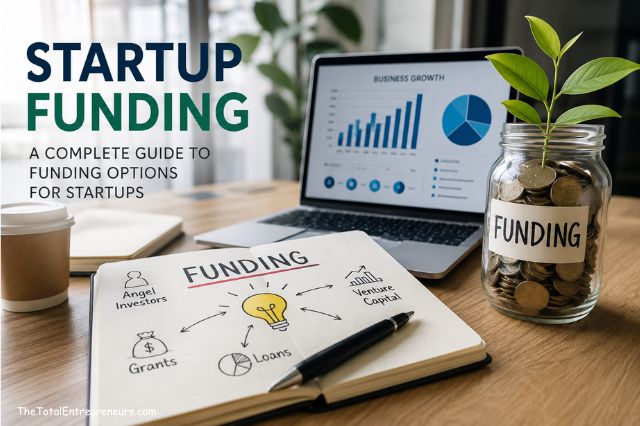
Want to start a business? That’s a great idea, but turning that idea into a sustainable company requires more than passion, a good product, and determination. Aside from business structuring, the headache most entrepreneurs face at some point is funding.
Startup funding can determine how quickly a company grows, how much ownership founders retain, how much financial risk they assume, and what kind of investors or partners they bring into the business.
The good news is that entrepreneurs today have more funding options than simply asking a bank for a loan or pitching a venture capitalist. Depending on the business model, stage, capital requirements, and growth ambitions, founders can choose from bootstrapping, friends and family, grants, angel investment, venture capital, crowdfunding, accelerators, loans, revenue-based financing, strategic investment, and other alternative sources of capital.
However, having many options can also make the decision more complicated.
The best funding source isn’t necessarily the one that gives you the most money. It is the one that provides the right amount of capital at the right time, at an acceptable cost and with terms that support your long-term objectives.
This comprehensive guide explains the major startup funding options, their advantages and disadvantages, when to use them, how investors evaluate startups, and how founders can build a funding strategy that matches their business.
“The best funding source is the one that provides the right amount of capital at the right time, at an acceptable cost and with terms that support your long-term objectives.”
What Is Startup Funding?
Startup funding refers to the money entrepreneurs use to launch, operate, develop, and grow a new business.
Funding can pay for expenses such as:
- Product development
- Market research
- Equipment
- Technology and software
- Salaries and hiring
- Marketing and customer acquisition
- Inventory
- Office or operational expenses
- Regulatory and legal costs
- Expansion into new markets
- Working capital
Startup capital generally comes from two broad categories:
- Equity financing
Equity financing involves receiving money in exchange for ownership in the company.
Examples include:
- Angel investment
- Venture capital
- Strategic investors
- Equity crowdfunding
- Some accelerator investments
The major advantage is that equity financing generally doesn’t require regular loan repayments. The disadvantage is that founders give up some ownership and potentially some control.
- Debt financing
Debt financing involves borrowing money that must eventually be repaid, usually with interest.
Examples include:
- Bank loans
- Microloans
- Business lines of credit
- Equipment financing
- Convertible debt
- Some forms of venture debt
Debt allows founders to retain ownership but introduces repayment obligations and financial risk.
The U.S. Small Business Administration similarly categorizes major funding routes around self-funding, investors, and loans, illustrating why the choice of financing can affect how a business is structured and operated.
Why Choosing the Right Startup Funding Matters
It can be tempting to focus entirely on the amount of money a funding source provides.
For example, an entrepreneur may think:
“If an investor offers me $500,000, I should take it.”
Not necessarily.
The more important question is:
What will that $500,000 cost me?
The cost may involve:
- Equity dilution
- Interest payments
- Loss of control
- Investor influence
- Board seats
- Reporting obligations
- Restrictions on spending
- Personal guarantees
- Pressure to grow rapidly
- Expectations of an exit
A funding decision made today can affect the company for years.
For example, raising too much equity capital too early may unnecessarily dilute founders. Conversely, refusing outside capital when rapid expansion is critical could allow competitors to gain an advantage.
Therefore, startup funding should be treated as a strategic decision rather than simply a search for cash.
Startup Funding Options
-
Bootstrapping: Fund the Startup Yourself
Bootstrapping is one of the most accessible startup funding options.
Instead of raising money from outside investors, founders use their own resources and business revenue to finance the company.
Sources may include:
- Personal savings
- Income from another job
- Revenue generated by the startup
- Reinvested profits
- Selling personal assets
- Freelance or consulting income
Advantages of bootstrapping
i. Maximum ownership
You don’t have to give investors a percentage of your company.
ii. Greater control
You can make decisions without seeking approval from external shareholders.
iii. Less fundraising pressure
Instead of constantly preparing investor presentations, you can concentrate on customers and operations.
iv. Financial discipline
Limited capital can force entrepreneurs to prioritize the activities that generate the greatest return.
Disadvantages
Bootstrapping also has limitations.
You may:
- Grow more slowly
- Have limited marketing resources
- Struggle to hire experienced employees
- Face personal financial risk
- Miss opportunities that require significant capital
Bootstrapping is particularly attractive for businesses that can become profitable without enormous upfront investment.
A software consultancy, digital agency, online education company, content business, or small e-commerce operation may be able to bootstrap more easily than a biotechnology or advanced hardware startup.
-
Friends and Family Funding
Friends and family are often among the first external sources of startup capital.
The arrangement can take several forms:
- Personal loans
- Equity investment
- Convertible loans
- Gifts
- Informal investments
The advantage is that people who know you may be willing to invest before traditional investors are prepared to take the risk.
However, this option carries an important non-financial risk: relationships can be damaged if the business fails.
Treat friends-and-family funding professionally.
Have written agreements explaining:
- How much money is being provided
- Whether it is debt or equity
- Repayment terms
- Ownership percentages
- What happens if the business fails
- Whether additional funding may be required
Never assume that a handshake is enough simply because the investor is a relative or close friend.
-
Startup Grants
Grants are another attractive funding source because they generally don’t require founders to give up equity.
Government agencies, nonprofit organizations, universities, development institutions, foundations, and corporations may offer grants for businesses working in specific sectors.
Potential areas include:
- Technology
- Agriculture
- Renewable energy
- Healthcare
- Education
- Financial inclusion
- Climate solutions
- Manufacturing
- Youth entrepreneurship
- Women-led businesses
- Social impact
Why grants are attractive
The biggest advantage is that qualifying entrepreneurs can receive capital without:
- Giving away ownership
- Paying interest
- Making regular loan repayments
The downside
Grants can be highly competitive.
They may also have:
- Strict eligibility requirements
- Application deadlines
- Extensive documentation
- Reporting requirements
- Restrictions on how money can be spent
Therefore, entrepreneurs shouldn’t build an entire funding strategy around grants.
Instead, treat grants as one component of a broader capital strategy.
-
Angel Investors
Angel investors are individuals who invest their personal money in startups.
Many angels are entrepreneurs, executives, business owners, or experienced professionals who can provide more than capital.
An angel investor may contribute:
- Industry knowledge
- Mentorship
- Business contacts
- Customer introductions
- Hiring assistance
- Strategic advice
- Follow-on investment
Angel investment can be especially valuable during the pre-seed and seed stages, when startups may not yet have enough traction to attract institutional venture capital.
What angel investors look for
Depending on the investor, they may evaluate:
- Founder quality
- Market opportunity
- Product
- Competitive advantage
- Revenue
- Customer growth
- Business model
- Scalability
- Market timing
- Exit potential
The SBA notes that venture funding processes commonly involve identifying suitable investors, presenting the business plan, undergoing due diligence, and negotiating investment terms.
-
Venture Capital
Venture capital, commonly called VC, is one of the most well-known forms of startup financing. Venture capital firms invest in companies they believe can achieve substantial growth and eventually generate significant returns. Unlike a traditional bank, a VC generally doesn’t expect its return primarily through loan repayments. Instead, the investor typically receives equity in the company.
Venture capital is not for every startup
This is one of the most important lessons entrepreneurs should understand. A profitable small business can be an excellent company without being a good venture-capital investment. VC investors generally look for businesses capable of producing large-scale growth.
A typical VC-backed startup may have characteristics such as:
- A large addressable market
- Scalable economics
- Strong growth potential
- Defensible technology or intellectual property
- Significant competitive advantage
- A capable founding team
- A credible path to a major exit
The venture capital trade-off
The founder receives capital and potentially valuable support but gives up equity.
The company may also face pressure to:
- Grow quickly
- Hire aggressively
- Expand geographically
- Raise subsequent rounds
- Pursue a major acquisition or IPO
This can fundamentally change how a company operates.
-
Pre-Seed and Seed Funding
Startup financing is often divided into stages.
Pre-seed funding
Pre-seed capital is generally used to turn an idea into an initial business.
Money may fund:
- Research
- Prototyping
- Product development
- Initial team members
- Customer validation
- Minimum viable product development
Common sources include:
- Founders
- Friends and family
- Angels
- Accelerators
- Grants
Seed funding
Seed funding is typically used when the startup has progressed beyond the initial idea and needs capital to establish product-market fit and begin meaningful growth.
Funding may support:
- Product development
- Sales
- Marketing
- Hiring
- Customer acquisition
- Operational infrastructure
Seed investors generally want evidence that customers actually want the product.
-
Accelerators and Incubators
Startup accelerators and incubators can provide a combination of funding, education, mentorship, workspace, networking, and investor access.
An accelerator may provide:
- Initial investment
- Structured training
- Mentorship
- Product guidance
- Investor introductions
- Demo days
- Access to a founder community
Incubators may support startups over a longer period and can be particularly useful during the early development stage.
However, entrepreneurs should examine the terms carefully. Some programs require equity in exchange for funding and support.
Before joining, investigate:
- Investment amount
- Equity required
- Program duration
- Mentorship quality
- Alumni outcomes
- Investor network
- Geographic requirements
- Follow-on investment opportunities
A prestigious program isn’t automatically a good fit for every founder.
-
Crowdfunding
Crowdfunding allows entrepreneurs to raise money from a large number of people, usually through an online platform.
There are several forms of crowdfunding.
Reward-based crowdfunding
People contribute money in exchange for rewards, early access, products, or other benefits.
This can work particularly well for consumer products.
Equity crowdfunding
Investors provide capital in exchange for ownership or securities.
Donation-based crowdfunding
Supporters contribute without expecting a financial return.
This is more common for charitable or social initiatives.
Debt crowdfunding
Individuals or institutions lend money to businesses with the expectation of repayment and interest.
Crowdfunding can provide capital while simultaneously validating market demand. If thousands of people are willing to pre-order a product, for example, that can demonstrate meaningful customer interest.
However, securities-based crowdfunding is regulated.
In the United States, SEC Regulation Crowdfunding permits eligible companies to raise up to $5 million in a 12-month period, subject to specific disclosure, intermediary, and investor requirements.
In Nigeria, the Securities and Exchange Commission has also established rules governing investment-based crowdfunding. SEC Nigeria states that eligible incorporated MSMEs can raise within specified thresholds and that crowdfunding must be conducted through registered intermediaries.
Entrepreneurs should therefore understand the securities laws applicable in their jurisdiction before launching an equity crowdfunding campaign.
-
Bank Loans and Business Loans
Debt financing can be a good option for businesses that have predictable cash flow and can comfortably service debt.
Common forms include:
- Term loans
- Working-capital loans
- Lines of credit
- Equipment loans
- Microloans
- Asset-backed financing
The major advantage is that you generally retain ownership.
The disadvantage is that the money must be repaid.
Before taking a loan, calculate:
Monthly repayment ÷ expected monthly free cash flow
If repayment consumes too much of your available cash, the loan could place the business under significant pressure.
Traditional lenders may also request:
- Financial statements
- Business plans
- Bank statements
- Credit history
- Collateral
- Cash-flow projections
- Personal guarantees
Requirements vary considerably between lenders and countries.
For example, the U.S. SBA-backed ecosystem includes 7(a), 504 and microloan programs, illustrating how debt products can be tailored to different business needs.
-
Microfinance and Microloans
Microfinance can be particularly relevant for very small businesses and early-stage entrepreneurs who may not qualify for traditional bank financing.
Microloans can be used for:
- Inventory
- Equipment
- Small-scale expansion
- Working capital
- Business assets
The amounts are generally smaller than conventional business loans.
This makes them potentially useful for entrepreneurs who need modest amounts of capital rather than hundreds of thousands or millions of dollars.
However, borrowers should carefully compare:
- Interest rates
- Fees
- Repayment frequency
- Collateral requirements
- Penalties
- Effective annual cost
Never evaluate a loan solely on the advertised interest rate.
-
Revenue-Based Financing
Revenue-based financing is an alternative form of business financing where an investor provides capital and receives a percentage of future revenue until an agreed repayment amount has been reached.
For example, instead of paying a fixed monthly loan repayment, a company might repay a percentage of monthly revenue.
This structure can be attractive to businesses with:
- Recurring revenue
- Predictable sales
- Strong gross margins
- Established customers
It may be less suitable for companies with highly unpredictable revenue.
The biggest advantage is that founders may avoid giving up traditional equity.
The potential disadvantage is that the total financing cost can be significant, particularly if revenue grows quickly.
-
Convertible Notes
A convertible note is a form of debt that can convert into equity later, usually during a future financing round.
Instead of immediately determining the precise value of the startup, investors provide capital under agreed terms and convert their investment into shares later.
Convertible notes may include provisions such as:
- Interest
- Maturity date
- Valuation cap
- Discount rate
- Conversion triggers
They can simplify early-stage fundraising, particularly when valuing a young startup is difficult.
However, founders should understand exactly how the conversion mechanism affects future ownership.
Professional legal advice is strongly recommended before issuing convertible securities.
-
SAFEs
A SAFE, or Simple Agreement for Future Equity, allows an investor to provide money to a startup in exchange for the right to receive equity in the future under specified conditions.
SAFEs are commonly associated with early-stage startup financing.
They can simplify fundraising because they typically don’t function like conventional loans with regular interest and maturity payments.
However, founders should not assume that “simple” means “risk-free.”
Multiple SAFEs can create significant future dilution.
Before signing, understand:
- Valuation cap
- Discount
- Conversion mechanics
- Pro-rata rights
- Existing ownership
- Expected future financing
Because securities laws and legal structures differ by jurisdiction, founders should obtain appropriate legal advice.
-
Strategic Investors and Corporate Venture Capital
Sometimes the best investor isn’t simply someone with money.
A strategic investor may provide capital while also bringing:
- Distribution
- Technology
- Manufacturing capability
- Industry expertise
- Customers
- Partnerships
- International market access
Large corporations sometimes operate corporate venture capital arms that invest in startups strategically relevant to their industries.
For example, a fintech startup might attract investment from a financial institution that wants exposure to emerging technology.
Strategic investment can therefore deliver value beyond the funding itself.
But founders should carefully evaluate potential conflicts of interest. An investor that becomes a major shareholder may gain access to sensitive information or influence strategic decisions.
-
Family Offices
Family offices manage wealth on behalf of high-net-worth families.
Some family offices invest directly in startups, particularly where the opportunity aligns with their investment interests or strategic expertise.
They may have advantages such as:
- Longer investment horizons
- Flexible investment structures
- Industry expertise
- Large capital capacity
- Potential for follow-on investment
However, family offices vary enormously.
Some invest like traditional venture capital firms, while others prioritize long-term ownership or strategic relationships.
Research the investor’s previous investments before approaching them.
-
Customer Financing and Pre-Sales
One of the most overlooked startup funding strategies is getting customers to finance the business indirectly.
This can happen through:
- Pre-orders
- Deposits
- Annual subscriptions
- Advance payments
- Purchase commitments
- Paid pilots
- Letters of intent
For example, a startup selling business software might secure several paying customers before fully developing its platform.
The revenue generated can then finance further development. This approach is powerful because it combines funding with market validation.
Instead of convincing an investor that customers will buy, the entrepreneur has evidence that customers already are.
-
Supplier and Trade Credit
Suppliers may allow businesses to receive goods or services today and pay later.
This is known as trade credit.
For businesses that sell physical products, trade credit can reduce the amount of working capital required.
For example:
- A supplier provides inventory.
- The business sells the inventory.
- Customers pay.
- The business pays the supplier.
This effectively helps finance the operating cycle.
However, entrepreneurs should negotiate carefully and avoid becoming dependent on short payment periods they cannot comfortably meet.
How Much Startup Funding Do You Actually Need?
One of the biggest mistakes founders make is raising money simply because funding is available.
Instead, determine your capital requirement systematically.
Start by calculating:
Startup costs
Examples:
- Registration
- Product development
- Equipment
- Technology
- Branding
- Legal fees
- Initial inventory
Operating expenses
Estimate:
- Salaries
- Rent
- Utilities
- Software
- Marketing
- Transportation
- Professional services
Working capital
Determine how much cash is needed to cover the period between spending money and receiving customer payments.
Contingency
Unexpected costs are inevitable.
A reasonable contingency reserve can help prevent a minor setback from becoming a financial crisis.
Understand Your Startup’s Runway
Runway measures how long your startup can continue operating before running out of cash.
A simple formula is:
Runway = Cash available ÷ Monthly net burn
For example, if a startup has $100,000 available and spends an average of $20,000 more than it earns each month:
$100,000 ÷ $20,000 = 5 months of runway
Runway is one of the most important metrics when planning a funding round.
Ideally, entrepreneurs should begin fundraising before cash becomes critically low.
How Investors Determine What Your Startup Is Worth
Valuation is one of the most challenging aspects of startup fundraising.
Investors may consider:
- Revenue
- Revenue growth
- Market size
- Customer acquisition
- Retention
- Gross margins
- Technology
- Intellectual property
- Competition
- Founder experience
- Business model
- Growth prospects
- Comparable companies
Early-stage startups often have limited financial history, so valuation can involve considerable judgment. Don’t focus only on achieving the highest possible valuation. A valuation that is unrealistically high can create problems during future funding rounds if the company cannot grow into it.
Startup Dilution: What Founders Need to Understand
Suppose you own 100% of a company.
You raise money by selling 20% of the company to investors.
After the investment, your ownership becomes approximately 80%, while investors own 20%.
This is equity dilution.
Dilution isn’t automatically bad.
If giving up 20% of your company allows the remaining 80% to become dramatically more valuable, the transaction may be highly beneficial.
The key question is:
Will the capital increase the value of the remaining ownership enough to justify the dilution?
Founders should also consider future funding rounds.
If the company raises additional capital later, ownership can be diluted again.
What Investors Want to See Before Funding a Startup
Before approaching investors, make sure your business can answer several fundamental questions.
Problem
What important problem are you solving?
Solution
How does your product or service solve it?
Market
How large is the opportunity?
Customers
Who is buying?
Traction
What evidence demonstrates demand?
Business model
How will you make money?
Competition
Who else is solving the problem?
Competitive advantage
Why can you win?
Team
Why are you the right people to build the company?
Financials
How much money do you need and what will you do with it?
Exit potential
How can investors eventually generate a return?
A startup doesn’t necessarily need to have all the answers, but it should demonstrate that the founders understand the business deeply.
Prepare Your Startup Before Fundraising
Before contacting investors or lenders, prepare your documentation.
A basic startup fundraising package may include:
- Executive summary
- Pitch deck
- Business plan
- Financial model
- Revenue projections
- Cap table
- Product demonstration
- Market research
- Customer data
- Legal documents
- Corporate registration documents
- Intellectual property documentation
- Bank statements
- Tax records where applicable
Your documents should tell a consistent story.
If your pitch deck says revenue is growing 50% while your financial statements tell a different story, investors will immediately notice.
Build a Strong Startup Pitch Deck
A typical pitch deck may contain:
- Company introduction
- Problem
- Solution
- Product
- Market opportunity
- Business model
- Traction
- Marketing and sales strategy
- Competition
- Competitive advantage
- Team
- Financial projections
- Funding requirement
- Use of funds
- Investment opportunity
The goal isn’t to overwhelm investors with information.
The goal is to make them interested enough to have a deeper conversation.
How to Approach Investors
Fundraising is partly a numbers game.
However, contacting hundreds of completely irrelevant investors is usually inefficient.
Research investors based on:
- Industry
- Geography
- Startup stage
- Typical investment size
- Previous investments
- Portfolio conflicts
- Investment thesis
A technology investor focused on Series B software companies may be a poor target for a pre-revenue agricultural startup.
Whenever possible, seek warm introductions through:
- Existing founders
- Business advisers
- Lawyers
- Accountants
- Accelerators
- Industry associations
- Professional networks
- Existing investors
Also read: Easy Tips For Finding Investors For Your Startup
Don’t Ignore the Terms of the Deal
The amount of funding isn’t the only thing that matters.
Carefully evaluate:
- Valuation
- Equity percentage
- Liquidation preference
- Voting rights
- Board seats
- Protective provisions
- Anti-dilution provisions
- Founder vesting
- Investor rights
- Information rights
- Conversion terms
- Exit provisions
A seemingly attractive investment can become expensive if the legal terms are unfavorable.
For significant transactions, engage an experienced startup lawyer.
Common Startup Funding Mistakes
Mistake 1: Raising too much too early
More money can create unnecessary dilution and pressure.
Mistake 2: Raising too little
Insufficient capital can leave the startup unable to achieve the milestones needed for its next stage.
Mistake 3: Choosing investors solely because they offer money
An investor should ideally bring strategic value and align with your goals.
Mistake 4: Ignoring dilution
Founders sometimes focus on the amount raised without understanding how much ownership they are giving away.
Mistake 5: Taking expensive debt
Debt that the company cannot comfortably repay can destroy an otherwise promising business.
Mistake 6: Fundraising before validating demand
Investors are more likely to take interest when founders can demonstrate customer demand.
Mistake 7: Poor financial records
Disorganized accounts can undermine investor confidence.
Mistake 8: Depending on a single funding source
A diversified funding strategy can reduce financial vulnerability.
How to Choose the Right Funding Option
Consider five major questions.
Question 1: How much money do you need?
A $10,000 requirement may not justify institutional venture capital.
A $10 million expansion may require institutional investors or significant debt financing.
Question 2: What stage is your startup?
Pre-revenue businesses have different options from companies generating millions in annual revenue.
Question 3: How quickly do you need the money?
Loans may sometimes be faster than equity fundraising, while grants can involve long application cycles.
Question 4: Are you willing to give up equity?
If the answer is no, consider:
- Bootstrapping
- Loans
- Grants
- Customer financing
- Revenue-based financing
Question 5: What kind of business are you building?
A venture-backed technology startup has different financing requirements from a restaurant, consultancy, retail business, or manufacturing company.
Also read: Importance of a Good Team: Lessons Learned From Founding Successful Investors
Startup Funding Options Compared
| Funding Option | Equity Given Up? | Repayment Required? | Best For |
| Bootstrapping | No | No | Early validation |
| Friends & family | Sometimes | Sometimes | Very early stage |
| Grants | No | Usually no | Specific sectors/projects |
| Angel investors | Yes | No | Pre-seed/seed |
| Venture capital | Yes | No | High-growth startups |
| Bank loans | No | Yes | Businesses with repayment capacity |
| Microloans | No | Yes | Small businesses |
| Crowdfunding | Depends | Depends | Consumer products/community-backed ventures |
| Revenue-based financing | Usually no | Yes, through revenue share | Revenue-generating companies |
| Accelerator | Usually | Usually no | Early-stage startups |
| Strategic investors | Yes | Usually no | Growth and strategic partnerships |
| Customer pre-sales | No | No | Product businesses |
| Trade credit | No | Yes | Inventory-based businesses |
| Convertible notes | Eventually | Usually converts | Early-stage startups |
| SAFE | Eventually | No traditional repayment | Early-stage fundraising |
A Practical Startup Funding Roadmap
A startup doesn’t necessarily have to choose one funding source forever.
A more effective approach may be to use different sources at different stages.
Stage 1: Idea
Potential funding:
- Personal savings
- Friends and family
- Grants
- Competitions
Objective:
Validate the idea.
Stage 2: Prototype
Potential funding:
- Bootstrapping
- Grants
- Angels
- Accelerators
Objective:
Build and test the product.
Stage 3: Early customers
Potential funding:
- Customer revenue
- Angel investment
- Seed funding
- Crowdfunding
Objective:
Demonstrate product-market fit.
Stage 4: Growth
Potential funding:
- Venture capital
- Strategic investors
- Revenue-based financing
- Business loans
Objective:
Scale sales, team, technology and operations.
Stage 5: Expansion
Potential funding:
- Growth equity
- Venture capital
- Debt
- Strategic investment
- Private equity
Objective:
Expand nationally or internationally and build a larger enterprise.
Startup Funding in Nigeria and Other Emerging Markets
Entrepreneurs in emerging markets may face challenges that differ from those encountered in Silicon Valley or other mature startup ecosystems.
These can include:
- Limited access to venture capital
- Higher borrowing costs
- Foreign exchange volatility
- Limited collateral
- Infrastructure challenges
- Smaller formal credit histories
- Regulatory complexity
As a result, Nigerian and African entrepreneurs may need to combine multiple sources of financing.
Potential sources include:
- Personal savings
- Business revenue
- Family and friends
- Angel networks
- Accelerators
- Government programs
- Development finance institutions
- Grants
- Commercial banks
- Microfinance institutions
- Crowdfunding
- Diaspora investors
- Strategic corporate investors
For Nigerian businesses considering investment-based crowdfunding, regulatory compliance is particularly important. SEC Nigeria’s crowdfunding framework includes requirements concerning eligible businesses, registered intermediaries, investor protections, disclosures and fundraising limits.
The lesson is simple: don’t copy a funding strategy from another country without adapting it to your own regulatory and financial environment.
How to Create a Startup Funding Strategy
Instead of asking:
“Where can I get money?”
ask:
“What type of capital best fits my business at this stage?”
Then follow these steps.
Step 1: Calculate your funding requirement
Determine exactly how much capital you need.
Step 2: Identify your next milestone
What will the funding accomplish?
For example:
- Build the MVP
- Acquire 1,000 customers
- Reach $1 million annual revenue
- Expand into three cities
Step 3: Determine your risk tolerance
Can you personally afford to guarantee a loan?
Are you comfortable giving up equity?
Step 4: Compare the true cost
Consider both financial and strategic costs.
Step 5: Research suitable funders
Target investors and lenders that understand your sector and stage.
Step 6: Prepare your documentation
Have your financials, pitch deck, legal documents and metrics ready.
Step 7: Start fundraising early
Don’t wait until the company has only a few weeks of cash remaining.
Step 8: Negotiate carefully
Don’t accept the first offer automatically.
Step 9: Use capital strategically
Every dollar, pound or naira raised should have a purpose.
Step 10: Measure results
Track whether the capital is producing the expected outcomes.
The Golden Rule of Startup Funding
The best startup funding is not necessarily the cheapest capital.
It is the capital that gives the company the best chance of achieving its objectives while maintaining a healthy balance between:
Growth + Control + Risk + Cost + Flexibility.
A founder who raises $1 million but gives up too much ownership may be worse off than a founder who raises $300,000 on better terms.
Likewise, a founder who refuses all outside investment may retain 100% ownership of a company that never reaches its potential.
The objective is not to maximize the amount of money raised.
The objective is to maximize the long-term value of the business.
Final Thoughts
Navigating startup funding can feel overwhelming, especially for first-time entrepreneurs. There is no universal funding strategy that works for every business.
A bootstrapped software company may have no reason to pursue venture capital. A biotechnology startup may need substantial equity investment because of years of research and development. A growing retail business might be better served by a bank loan or working-capital facility. A consumer product company could use pre-orders or crowdfunding to validate demand before approaching investors.
The smartest entrepreneurs therefore evaluate funding based on their business model, growth stage, capital requirements, cash flow, risk tolerance, ownership objectives and long-term vision.
Start with the smallest amount of capital that can help you achieve a meaningful milestone. Build evidence that customers want your product. Maintain accurate financial records. Understand dilution and debt. Research investors carefully. And never sign a funding agreement without understanding exactly what you are giving in return.
Ultimately, startup funding is not just about getting money.
It is about finding the right financial fuel to turn a promising idea into a sustainable and valuable company.
Frequently Asked Questions About Startup Funding
What is the best way to fund a startup?
There is no single best method. Bootstrapping can work well for low-cost businesses, while angels and venture capital may be more appropriate for startups seeking rapid, scalable growth. Loans can work well for businesses with predictable cash flow and repayment capacity.
How much money should I raise for my startup?
Raise enough to reach a clearly defined milestone while maintaining an appropriate cash buffer. Avoid raising an arbitrary amount simply because investors are willing to provide it.
Can I start a business without investors?
Yes. Many businesses can be launched through bootstrapping, customer revenue, grants, pre-sales, family funding, or loans.
Do I have to give up equity to get startup funding?
No. Grants, loans, bootstrapping, customer financing and certain alternative financing structures can provide capital without traditional equity dilution.
What is the difference between angel investors and venture capitalists?
Angel investors generally invest their personal money and often participate at earlier stages. Venture capital firms invest pooled institutional capital and typically target startups with significant growth potential.
Are startup grants free money?
Grants generally do not require repayment or equity, but they often have strict eligibility requirements and restrictions on how funds can be used. They are therefore not “free money” in the practical sense; entrepreneurs must meet the program’s conditions and reporting requirements.
Should I take a startup loan or raise equity?
It depends on your business. If you have predictable cash flow and can comfortably repay the debt, a loan may allow you to retain ownership. If your business is early-stage, highly uncertain and focused on rapid growth, equity may be more appropriate.
What should I do before approaching investors?
Validate your idea, understand your market, establish a business model, document your financials, identify your funding requirement, define your milestones and prepare a compelling pitch deck.
What is startup runway?
Runway is the amount of time a startup can continue operating before its cash runs out. It is typically calculated by dividing available cash by monthly net cash burn.
Can a startup use multiple funding sources?
Absolutely. In fact, combining funding sources can be an effective strategy. A founder might bootstrap initially, obtain a grant, raise angel investment, generate customer revenue and later use venture capital or debt to scale.
Please note: Funding structures, securities regulations, loan requirements, tax treatment and investment rules vary by country and can change over time. The regulatory examples above are provided for general educational purposes and should not be treated as legal, tax or investment advice. As a Founder, you are encouraged to consult qualified financial and legal professionals before entering significant financing transactions.
To your success.